Cultural London Walk:
From the bizzare to torture to art, explore the south bank of London. Imbibe hundreds of years of history then move to the contemporary. Cultivate your soul with some culture by visiting the Shakespeare's Globe and the Tate Modern art gallery.
Don't worry, there will be plenty of opportunities for eating and drinking along the way.
Start: Waterloo station
End: London Bridge station
At the Waterloo station,take exit 6, for the South Bank. Follow the signs. The London Eye is located on the South Bank of the Thames on the left, opposite the Houses of Parliament.
Waterloo Station: Opened in 1848 as 'Waterloo Bridge Station' and totally refurbished in 1899. The new station included a large stained glass window depicting the L&SWR's company crest over the main road entrance. The station was damaged during the World War I.
Westminster Bridge which became known as the 'Bridge of Fools' opened in 1862. For 600 years London Bridge was the only crossing in central London, the nearest bridge was at Kingston. In 1909 a Roman boat discovered near the bridge. The Bridge is the start and finish point for the Bridges Handicap Race, a traditional London running race.
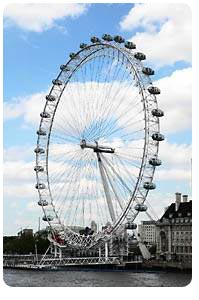
London Eye: is a tallest ferris wheel in Europe with giant pods. A complete turn takes about 30 minutes. It is the most popular paid tourist attraction in the UK, visited by over 3 million people a year. You can even have a wine tasting or a choclat tasting session while taking in 360 degree view of London. The Eye is the focal point of London's New Year celebrations, with a 10-minute fireworks direct from the wheel.
Adult: From £17.28 - £40
Child, 5-15: From £11.07
Child, under 4: Free
Family of Four: £50.40
County Hall Gallery: located between the London Aquarium and the London Eye, this large Edwardian style gallery cum Hotel houses a Dali museum (Dali Universe), the Saatchi Gallery, London Aquarium and a Namco Station amusement arcade.
|
 |
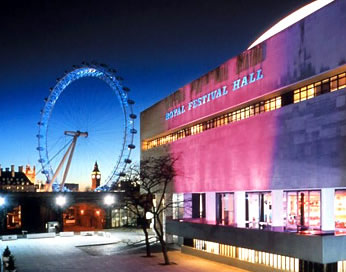
Walk towards the Waterloo Bridge. Face the Royal Festival Hall.
|
The Southbank Centre:: Built in 1951 as part of the Festival of Britain, is the largest single-run arts centre in the world, includes Royal Festival Hall, Hayward Gallery, Queen Elizabeth Hall, Purcell Room.
Nearly a thousand paid performances and few hundred free performances of music, dance and literature are staged at Southbank Centre yearly.
Southbank centre has plans for £100m redevelopment. These include a floating, transparent glass pavilion for orchestras and choirs.
|
Walk under the Waterloo Bridge, after crossing the National Theatre. Keep walking along the river until you reach Gabriel's Wharf
|
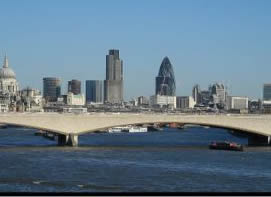
Waterloo Bridge: is a road and foot traffic bridge crossing the River Thames in London. The first bridge opened in 1817. By the 1920s, the bridge faced major problems. It was demolish and replaced with a new structure It was re-opened in 1945. It was rebuilt a second time in 1970. Finally, the bridge was rehabilitated by the state in 1987.
Georgi Markov, a Bulgarian dissident was assassinated on Waterloo Bridge by Bulgarian secret police assisted by the KGB. On 7 Sept 1978, Markov crossed Waterloo Bridge, when he was jabbed in the leg by a man holding an umbrella. Markov developed a high fever. He died in agony three days later. After his death, doctors found a small platinum pellet embedded in his calf. Further examination found that two small holes had been drilled in the bullet containing traces of the poison ricin.
|
 |
Gabriel's Wharf has many art and design shops, cafes, bars and restaurants.
The OXO Tower: The tower was built as a power station a centuary back. It today offers the best in contemporary jewellery, lighting, homeware and fashion. There are also cafes and restaurants including the famous Oxo Tower Restaurant & Brasserie and exhibition spaces.
At the top, the embedded OXO logo is visible in glass, to get around a ban on sky advertising during World War II..
Cross the Doggett's pub and then the Blackfriars Underpass. Keep walking after crossing the alloy gates, passing a Victorian archway.
Cross the tunnel. Stop at the Founders Arms pub on the left.
|
Doggett's Coat and Badge Pub: The pub was named after a traditional annual event that has been held regularly every July since 1715. It is a boat race on the Thames from Tower Bridge to Chelsea and is called the Doggett's Coat and Badge race from where this Pub gets it's name. The winning waterman is assigned to the Royal team who get to escort the Queen when she travels along the Thames.
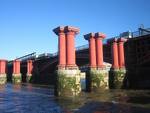
Blackfriars Bridge across the Thames is so called in honour of an order of Monks who first came to London in 1279. The bridge itself was built in the late 19th century and was inaugrated by Queen Victoria in 1899. It was named Black Friars after the monks. Earlier a rail bridge ran parallel to this bridge but that fell into disuse and was dismantled.
|
Crossing the Founders Arms pub, reach the Tate Modern
Tate Modern Started in 2000 and is housed in the old Bankside Power Station.
The Gallery houses UK's collection of modern and contemporary art from 1900 to the present day. Its collection has classics by Cézanne, Bonnard, Matisse, Picasso, Rothko and Dali. Admission is free except for special exhibitions. It is Ranked #6 things to do in London by Lonely Planet.
Spot an passageway on the right called the Cardinal Cap Alley.
Cardinal Cap Alley was built in the late 16th Century. This area was notorious for medieval brothels. The oldest existing building, Cardinal Wharf (number 49), dates from during the 18th Century.
Continue to the Globe Theatre and Exhibition Centre.
|
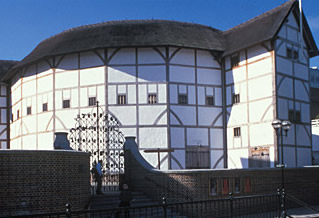
Shakespeare's Globe Theatre: Built in the Shakespearean era, it was destroyed by fire in 1613. The Globe was then closed down by the Puritans in 1642. It was reconstructed and later opened in 1997 in the modern times.
The modern Shakespeare’s Globe is a faithful reconstruction of the open-air playhouse designed in 1599.
Explore the life of Shakespeare, the London where he lived, and the theatre for which he wrote. Also within are sculptures of animals from some of Shakespeare's plays.
|
|
You can now cross the Globe Theatre and walk upto the second turning on the right and you will reach the Bear Gardens. This will lead into a narrow lane with restaurants on either side. You will be at a junction which faces the restaurant wall on the other side. You will notice an odd sort of embeddment in this wall which looks like a seat.
As you walk towards the Bear Gardens you will notice the Davies Amphitheatre on your left. In this area on the Bankside this was the last of the bear-baiting pits.
Cross Bear Gardens, Park Street and turn left. Pass the Rose Theatre.
If you keep walking adjacent to Park Street you will pass below Southwark Bridge and get to see the building of the Financial Times towards the left as sson as you exit from under the bridge. You can rest for a while opposite the flats across the Financial Times building.
Original Globe Theatre: An important discovery about the original Globe Theatre was made in 1989 when it's original foundations were discovered. These have been preserved below the Old Theatre Court, flats in front of the building of the Financial Times.
Continue to walk along Park Street until you come to the end. Turn left here and you notice a raised area where sitting arrangements are made that overlook the Thames near a pub Anchor Tavern.
The Anchor Tavern : replaced an earlier inn which existed here and was constructed in 1775. The older infamous inn was the same from which Samuel Pepys had watched, across the Thames, the great fire of London. It was also the first of the licensed brothels of the Church called ' Le Castell upon the Hoop'. As a testimony to the dominance of the Bishop's over this area, four iron posts can still be seen. You also get a good view of six bridges of London from the Anchor Tavern.
Filming of one of the scenes from Mission Impossible was shot here.
Walk across Clink Street, crossing the Clink Prison exhibition. View the ruins of the 12th centuary Winchester Palace.
Winchester Palace : Was the palace of the corrupt and powerful Bishops of Winchester in the 12th centuary. Now only the ruins of the Great Hall remain. The Palace was destroyed by fire in 1814.
Situated right next door is the Clink Prison Museum..
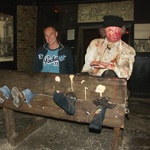
Clink Prison Museum: This notorious prison were owned by the Bishops of Winchester. The Prison was used to control the Southbank. The museum recreates the conditions of the prison; lit by candles, and covered in sawdust. With the moans and groans coming from the waxworks it can be a spooky place. A waxwork man hanging in a cage welcomes you down the stairs with groans at the entrance.
Arranged into a series of cells, it has such exhibits as a whipping post, torture chair, foot crusher, and other torture implements.
Get a hands-on experience of all torture devices, many of which are original. There is a scolds bridal, and ball and chains are around the museum in various places. There are pictures and waxworks of people that would have been held there.
Admission: Adult £7.00.
Opening Times: Daily 10.00-18.00. Closes 21.00 Sat & Sun |
|
Our next destination is the Southwark Cathedral. To reach its grounds continue to walk along Clink Street until you reach the end which is a small junction. You will pass the Golden Hinde on the left side. From here you go right and the left side path will lead you to the Southwark Cathedral.
|
Southwark Cathedral : Oldest Gothic church in London (c1220) with interesting memorials connected with the Elizabethan theatres of Bankside. Window and memorial to William Shakespeare, burial place of his brother Edmond. A chapel commemorates John Harvard, benefactor of Harvard University and there are choral services with the fine Lewis organ. An archaeological chamber reveals a Roman road and 17th century Southwark Pottery Kilns. There is a shop and refectory/restaurant. Landscaped gardens with Shakespearean and biblical painting.
Edmund Shakespeare, a brother of William Shakespeare was an actor and his body is interned in the church. There is also a plaque devoted to the founder of the present Globe theatre Sam Wanamaker besides a statue of Shakespeare in the Cathedral.
|
London Bridge: Until 1750, The London Bridge was built in stone for the first time in 1176 and was the only bridge across the Thames for almost six centurites until the year 1750. The first bridge was originally built as a pontoon by the Romans comprising a series of boats which kept getting replaced by a series of wooden bridges upto 1176, the year when the stone bridge was erected at this location. much less impressive bridge as it exists now, in 1973.
That in the medieval times, the persons declared traitors would have their heads chopped off and their decapitated heads would be mounted on the spikes on the gates on both ends of London Bridge for public display. This was also the fate of the Braveheart William Wallace who was beheaded in 1305 and the head was so displayed.
It is now time to get out from the Southwark Cathedral grounds. As you come out you can see the Borough Market area .
Borough Market: there is strong evidence cited by historians to indicate the existance of a market here going back to even before Roman times.
Presently, the market caters to fruit and vegetables demand but only wholesale trade is carried. It is therefore flourishing with activity eaarly morning from 2am onwards upto 9am in the morning and is patronised by business like green grocer shops and hotels who buy their daily requirement directly from the wholesale traders.
This market opens to the public over an extended weekend from Thursday to Saturday in the morning after the wholesale trade upto mid afternoon.
Walk along the market reaching Borough High Street.Turn right here and stop before the traffic lights.
Borough High Street is located where there used to be a Roman road in medieval times. This raod dissected an important borough area and has the distinction of having the longest known history for any area of London.
As you go along the street, you can see a number of narrow alleys on either side leading from the street between houses. These medieval allies and the buildings were the resting point for travellers for centuries before venturing into the city across the London Bridge .
on Southwark Street and then Borough High Street. Take a right turn here and proceed along Borough High Street. Shortly you will pass the George Inn which you can see on your left. At the next traffic signal on Borough High Street cross over again to Union Street and after a short walk turn left to reach its junction with Redcross Way.
The George Inn: This ancient building dating back to the 16th century on the left side of Borough High Street is located in the George Inn courtyard and is probable the only surviving gallery that was also a coaching inn. The building that you see today is not the complete building as was built in 1576 but only a small part of the original.
An interesting fact is that the courtyard of this building served as a theatre where plays were performed before the Globe Theatre opened in 1599 and it is known that the great Shakespeare himself used to perform here.
From here go back to Borough High Street as you came and this time turn right to reach the St George the Martyr Church. You will find this church opposite Borough station.
"Little Dorritt's" Church: as St George the Martyr Church is known was originally constructed in early 12th century and stoof for almost 600 years. It was re-built in 1736 and got its name "Little Dorritt's Church" because of Charles Dickens' novel 'Little Dorritt' in which it is featured.
The novel is the story of a girl Little Dorritt who is born in the nearby 'Marshalsea Prison'. The girl sleeps in the church when she is locked out one night and It is also where she gets married in the novel's ending.
Take a turn towards the left on to Tabard Street.
At Crosby Row take a left turn, walk upto the end where you will find the Guys’ Hospital. Walk into the grounds of the hospital and walk right across to the other side. Take a left turn along St Thomas Street after coming out of the grounds.
Keep walking up to the end of St Thomas Street and take a left turn to reach London Bridge station of the tube. |