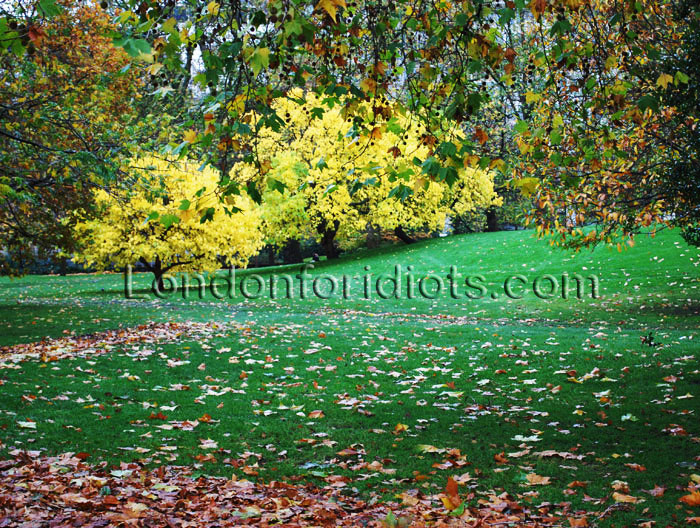
St James's Park: St James's Park is the oldest Royal Park in London and is surrounded by three palaces. The most ancient is Westminster, which has now become the Houses of Parliament, St James's Palace and of course, the best known, Buckingham Palace. St James's Palace with its Tudor style still holds the title of the Court of St James despite the fact that the Monarch has lived in the third palace, Buckingham Palace since 1837.
The Park was once a marshy watermeadow. In the thirteenth century a leper hospital was founded, and it is from this hospital that the Park took its name. Charles II redesigned the Park with avenues of trees planted and lawns. The King opened the park to the public and was a frequent visitor, feeding the ducks and mingling with his subjects.
Outside Buckingham Palace is the Queen Victoria Memorial, which celebrates the days of the British Empire. The memorial includes not only the marble statue of Victoria and the glittering figures of Victory, Courage and Constancy, but also the ornamental gates given by the Dominions. These are the Australia Gate, South Africa Gate and Canada Gate.
St James Park Attractions
The Queen Victoria Memorial commemorates the death of Queen Victoria in 1901 and is located at the front of Buckingham Palace.
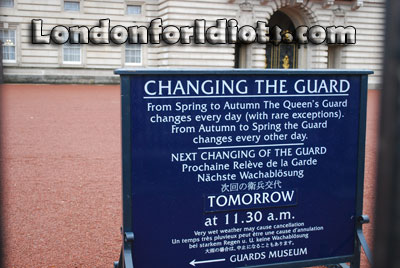
Changing the Guard is one of the most familiar ceremonies associated with Buckingham Palace where the New Guard exchanges duty with the Old Guard.
The Diana Princess of Wales Memorial Walk is a seven-mile-long walk, charted by 90 plaques set in the ground, that takes you within sight of famous buildings and locations associated with the Princess during her life.
The Beating Retreat: Over two successive evenings, 12 - 13 June 2013, Horse Guards Parade plays host to the floodlit musical spectacular of Beating Retreat by the massed bands of the Household Division.
Once a year, to mark the Queen's official birthday Trooping the Colour is held on Horse Guards Parade in St James's Park.
Flora and Fauna
St James's Park, the first of The Royal Parks to be opened to the public, provides habitats for a variety of different species. One of the key habitats in St James's Park is the lake. It is home to a wide range of birdlife (including 15 different species of waterfowl) and has nesting sites on Duck Island and West Island.
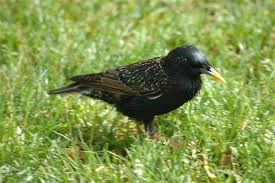
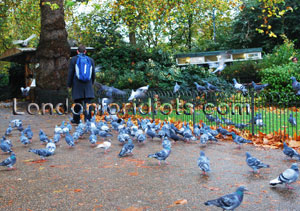
Wildlife: Duck Island is the home to many wild breeds of beautiful ducks and bird life. There are many ducks; gulls; swans; geese; pelicans. Other rarer visitors are the golden eye, carrion crows, grey wagtail and shovelers.
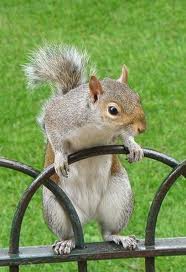
Although the park has foxes, Wood Mice and Brown Rats these are largely active at night and it is the overly friendly Grey Squirrel, is the most likely mammal for visitors to see.
The majority of trees in the park are Plane trees, which can be seen running alongside The Mall, Birdcage Walk and Horse Guards Parade.
Opening hours: The park is open from 5am to midnight all year round.
Getting there:
Tube:
St. James's Park - District,Circle Line
The Park is also easily accessible from Charing Cross Station - Northern, Bakerloo, BR lines
Westminster - Jubilee, District & Circle Lines
Green Park - Piccadilly, Victoria & Jubilee Lines
Victoria - Victoria, Circle & District, BR lines
Bus:
3 Oxford Circus - Crystal Palace
11 Liverpool St - Fulham Broadway
12 Oxford Circus - Dulwich Plough
24 Pimlico - Hampstead Heath
29 Wood Green - Trafalgar Square
53 Trafalgar Square - Plumstead Common
77a Aldwych - Wandsworth
88 Camden Town - Clapham Common
91 Crouch End - Trafalgar Square
148 Shepherd's Bush - Camberwell
159 Marble Arch - Streatham
211 Waterloo - Hammersmith
453 Marylebone - Deptford
There are no parking facilities.
Park Facilities
Facilities in the Park include a children's playground and deck chairs (April-September). Disabled toilets are available.
Deck Chairs
Semnat & Associates (trading as Parkdeckchairs) operates the deck chair service in all relevant Royal Parks.
Availability: Deck chairs are available from March to October during daylight hours, weather permitting.
Deck Chair Pricing
Up to 1 hour: £1.50
Up to 3 hours: £4.00
All day usage: £7.00
Inn the Park
Inn the Park is a restaurant for all seasons, located in St James's Park. Facilities include toilets and baby changing, and high chairs. The restaurant is licensed for alcohol, and also offers picnic hampers and a range of merchandise.
Location: West of Horse Guards Parade
For bookings: Tel. +44 (0)20 7451 9999
Open: Mondays - Fridays 8am to 11pm, Saturdays and Sundays 9am to 10pm
Refreshment Points
Refreshment Points offer bean to cup coffee, ice cream, snacks and freshly made sandwiches.
Location: Marlborough Gate, Horse Shoe Bend, Artillery Memorial and the playground.
History
The Park was once a marshy watermeadow. In the thirteenth century a leper hospital was founded, and it is from this hospital that the Park took its name. In 1532 Henry VIII acquired the site as yet another deer park and built the Palace of St James's. When Elizabeth I came to the throne she indulged her love of pageantry and pomp, and fetes of all kinds were held in the park. Her successor, James I, improved the drainage and controlled the water supply. A road was created in front of St James's Palace, approximately where the Mall is today, but it was Charles II who made dramatic changes. The Park was redesigned, with avenues of trees planted and lawns laid. The King opened the park to the public and was a frequent visitor, feeding the ducks and mingling with his subjects.
During the Hanoverian period, Horse Guards Parade was created by filling in one end of the long canal and was used first as a mustering ground and later for parades. Horse Guards Parade is still part of St James's Park. The Park changed forever when John Nash redesigned it in a more romantic style. The canal was transformed into a natural-looking lake and in 1837 the Ornithological Society of London presented some birds to the Park and erected a cottage for a birdkeeper. Both the cottage and the position of birdkeeper remain to this day. Clarence House was designed for the Duke of Clarence, later to become William IV and was also the home of the late Queen Elizabeth, The Queen Mother.
King James kept a collection of animals in the park. They included camels, crocodiles and an elephant. There were also aviaries of exotic birds along what is now Birdcage Walk. And next to St James's Palace, King James created a flower garden.
The park became more formal when Charles II became king in1660. He had been in exile in France after the English Civil War and had been impressed by the elaborate gardens belonging to the French royal family. When Charles returned home, he ordered the redesign of St James's Park.
The new park was probably created by the French landscaper, Andre Mollet. The centrepiece was a straight canal, 2,560ft long and 125ft wide, lined on each side with avenues of trees. The new park was opened to the public for the first time.
Outside Buckingham Palace is the Queen Victoria Memorial, which celebrates the days of the British Empire. The memorial includes not only the marble statue of Victoria and the glittering figures of Victory, Courage and Constancy, but also the ornamental gates given by the Dominions. These are the Australia Gate, South Africa Gate and Canada Gate.
The park you see today is still very much as Nash designed it and there have been only small changes since. Traffic was allowed to use The Mall in 1887. The Marble Arch outside Buckingham Palace was moved to the junction of Oxford Street and Park Lane in 1851. The area outside Buckingham Palace was remodelled between 1906 and1924 to make space for the Victoria Memorial. An elegant suspension bridge was built across the lake in 1857 and was replaced 100 years later by the concrete one we see today.
The most recent changes aim to complement Nash's work. The shrubberies are being restored in the spirit of his ideas and a new restaurant, which opened in 2004, was designed to blend into the romantic landscape. |