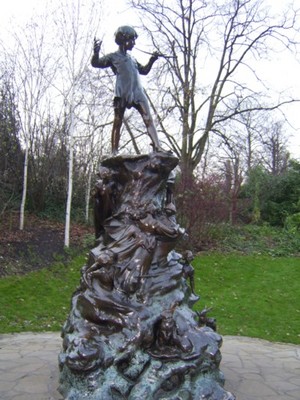
Kensington Gardens is an extension of Hyde Park and covers an area of 260 acres. Kensington Gardens is planted with formal avenues of magnificent trees and ornamental flower beds. It is a perfect setting for Kensington Palace, peaceful Italian Gardens, the Albert Memorial, Peter Pan statue and the Serpentine Gallery.
The Gardens are particularly popular for sunbathing and picnics in fine weather. It is also popular as a healthy walking route to work for commuters. The paths are used extensively by joggers and runners. Cycling is allowed on the designated path linking the Queen's Gate to West Carriage Drive, Mount Gate to the Broadwalk and the Broadwalk itself from Black Lion Gate to Palace Gate.
The main attraction of the garden is the Boating Pond where locals try out their model boats.
There are statues of John Hanning Speke, the explorer who discovered the Nile; Edward Jenner, who developed a vaccine for smallpox; and even Peter Pan. ( The statue was erected in secret during the night and 'magically' appeared on 1st May 1912.) Most recently, in 2000, a children's playground opened in memory of Diana, Princess of Wales.
Bird records for Kensington Gardens are more than a hundred years. 178 species have so far been identified. Green Woodpeckers nest in the Gardens - a rare occurrence in Central London.
Kensington Gardens in film
The fountains in the Italian Garden near Bayswater Road, the Albert Memorial off Kensington Gore and the Serpentine Gallery have all featured in successful films.
The most fitting film to be shot here must be Finding Neverland (2004). This is the story of the novelist J M Barrie, who was inspired to write Peter Pan during afternoon strolls in the Gardens more than 100 years ago. Barrie (played by Johnny Depp) makes friends with Sylvia Llewellyn Davies (Kate Winslet) and her four sons. The film uses Kensington Gardens for the scenes where Barrie meets the boys and then entertains them with his imaginative stories. Watch the film carefully and you might find the very bench in the Gardens that Michael Llewellyn Davies (Luke Spill) hides under when he first meets Barrie.
Kensington Gardens is also a star location in Bridget Jones: The Edge of Reason, the 2004 sequel to the phenomenally successful Bridget Jones's Diary. Mark Darcy (played by Colin Firth) challenges Daniel Cleaver (Hugh Grant) to a fist fight over Bridget (Renee Zellweger) begins at The Serpentine Gallery and ends up as an water fight in the central basin of the Italian Garden.
The Italian Garden also features in Wimbledon (2004), the romantic comedy about tennis hot-shot Lizzie Bradbury (played by Kirsten Dunst) and Peter Colt (Paul Bettany), who is making his final appearance at the All England Championships. During a break from the tournament, the couple tour London, visiting the Gardens and the Albert Memorial.
About the Park
William III bought what was originally part of Hyde Park in 1689. An asthma sufferer, the king found the location quiet and cool. He commissioned Sir Christopher Wren to redesign the redbrick building that is Kensington Palace. Queen Anne enlarged the Palace Gardens by 'transferring' 30 acres from Hyde Park and was responsible for the creation of the Orangery in 1704. The focus of the new garden was Kensington Palace and the Round Pond. Each avenue gave a different view of the palace.
Kensington Gardens Attractions
The Albert Memorial is one of London's most ornate monuments. It commemorates the death of Prince Albert in 1861 of typhoid.
The Italian Gardens is a 150-year-old ornamental water garden located on the north side of Kensington Gardens near Lancaster Gate. It is believed to have been created as a gift from Prince Albert to his beloved Queen Victoria.
The Peter Pan statue features squirrels, rabbits, mice and fairies climbing up to Peter, who is stood at the top of the bronze statue.
The Serpentine Gallery is one of London's best-loved galleries for modern and contemporary art. It is open 7 days a week from 10am - 6pm and admission is free.
Diana Memorial Memorial Walk is a seven-mile-long walk, charted by 90 plaques set in the ground, that takes you within sight of famous buildings and locations associated with the Princess.
The Elfin Oak is a sculpture made from the hollow trunk of an oak tree that is carved with figures of fairies, elves and animals.
Kensington Palace is a royal palace overlooking the Round Pond in Kensington Gardens. It has been a royal residence since the 17th century. Areas of Kensington Palace are open to the public.
The Speke Monument is a red granite statue dedicated to John Hanning Speke, the explorer who discovered Lake Victoria and led expeditions to the source of the Nile. It is located near the junction of Lancaster Walk and Budges Walk.
Opening hours: The park is open from 6am to dusk all year round.
Nearest tube: High St. Kensington - Circle and District Lines
Lancaster Gate & Queensway - Central Line
Bayswater - District Line
|